Showing posts with label design. Show all posts

Thursday, February 18, 2021

Privacy, Hierarchy, and the 'Open' Reference Office

     Over the past eight years, there hasn’t been a single academic library that I’ve entered that didn’t have a bright and enticing Learning Commons. These large, open spaces have quickly become a modern staple in academic libraries looking to offer students with an aesthetically attractive ‘one-stop-shop’ for their research and study space, complete with fun technological equipment, various information service departments, and rearrangeable furniture & whiteboards. Comparisons between the group-oriented, supportive environment of Learning Commons and the “holistic, nurturing environment”1 that feminist librarians aim to facilitate are easy to make. But, how might the open interior design of Learning Commons hinder a supportive and secure environment for patrons when coming to reference desk spaces with personal or sensitive research? Additionally, how might library workers also be affected by the architectural choice to expose reference offices when considering “how organizational spaces are simultaneously gendered and gendering” environments through placement, visibility, and lighting?2 Using my experiences working with students in the reference offices at two separate academic libraries (labelled #1 & #2), I argue that applying Learning Commons design methods to reference assistance spaces can both worsen library anxiety, particularly for marginalized groups, and heighten a pressure for library workers to perform while serving patrons, particularly in a field when women work the majority of desk assistance positions.3 I finish by proposing how feminist ethics of care & empathy and theories of spatial gender-class work can be used to balance the needs for patrons to feel that a reference desk is findable, approachable, and a safe space to express their needs & research ideas.

Surveillance & Gendered space for Library Workers

     While working at library #1, I saw a stark contrast between the architectural layouts of the reference and administrative spaces at the library. The reference office was brightly lit with two glass walls that allowed visitors to easily view the reference desk and the dual-screen reference assistance computer screens. This office was mainly staffed by cisgender women. The office was also placed in a high-traffic area on the first floor next to the computer lab and a small Learning Commons space to increase the amount of walk-in assistance4. In contrast, the administration office was on the second floor with enclosed walls and only two glass doors that provided a birds-eye view of the first floor. This space mainly contained the offices of library positions held by cisgender men.5 In their work on spatial gender dynamics and organizational aesthetics, Varda Wasserman and Michal Frenkel identify how sexist and classist hierarchies are reinforced by architectural design, such as only providing secluded office space for higher management positions more often held by men and using the openness of office spaces created for lower desk workers as an opportunity to surveil women workers’ adherence to dress code and procedure. In my experience working in this glass-walled reference office as a nonbinary person frequently perceived as a woman, I often felt pressured to perform a socialized stereotype of feminine customer service rather than authentic assistance when being viewed by the cisgender men in the highest library administration positions. It could also be argued that this type of surveillance and power dynamics could cause library workers to develop a sense of “detached professionalism” that lacks an ethics of care as discussed by Michelle Caswell and Marika Cifor.6 In this way, the stark contrast and physically hierarchical spatial layout of the reference office and administrative office, along with the gender divide between the offices, reinforced patriarchal power dynamics in the reference office that can remove a sense of safety and care from a reference space. 

Hypervisibility of Reference Offices & Library Anxiety

     While the power dynamics between the reference and administration spaces can limit the amount of authentic care and attention a library worker can bring to reference assistance, the patron-to-patron visibility of open-concept reference offices can also heighten library anxiety for a patron. Openness and visibility is often boasted as the ideal for information desks in academic libraries but reference desk assistance can vastly differ from the impersonal directional or technical assistance requested at circulation desks, with patrons often looking for more in-depth consultation about their personal research or interests. In Feminist Pedagogy for Library Instruction, Maria Accardi discusses how library anxiety, anxiety that a patron has at approaching library workers for assistance, disproportionately affects patrons from marginalized groups such as women, people of color, and queer folk. In addition, Accardi explains how a patron’s “query will be filtered through that anxiety, which will make it difficult for the learner to express what they need and desire” (40).7 When seeing reference spaces that are completely exposed by transparent walls with large computer screens, I can’t help but be concerned with how marginalized patrons may feel with this lack of privacy. For instance, while working at academic library #2, a roughly 2.5ft x 4ft flat screen TV was used in lieu of a desktop screen (to make the screen easier for a patron to see) that unfortunately broadcasted a patron’s research topic to anyone walking past the office. When a freshman student came into the office looking for assistance finding sources on representations of gender dysphoria through art, I perceived their questions and responses becoming short & shorter as more people looked into or entered the desk space. From my experience, the publicity of this patron’s interests, in relation to their own self-proclaimed identity as gender queer, seemed to be the source of their anxiety. This interaction shows how the lack of private space around reference desks can particularly worsen barriers to comfortable library service for marginalized patrons.     

Feminist Ethics-based Solutions

     So, how can librarians and library designers balance the need of open learning space designs while also providing space for private consultation and care? One simple solution that a feminist librarian could pursue that wouldn’t involve costly renovations could be to apply semi-opaque window sticks to the glass walls in transparent offices.8 The glass covers could function as an additional layer of privacy around the reference desk while also being printed with additional signage for the reference desk, possibly making up for the loss of direct visibility of the desk. Along the suggestions of Varda and Frenkel, the glass covers could also be an opportunity to introduce more color and creativity into stark, institutional environments. This reconstruction of the office space through color and signage could also create a more inviting space that could visually build privacy and breakdown conventionally bland office spaces. Another feminist ethics/pedagogy approach is to work around large, hyper visible computer screens. This can be done in the initial reference interview by being upfront with the patron and asking if they would rather want to use their own laptop in order to keep their research topic private to patrons and librarians that may pass by the office. By prioritizing the privacy of the patron and the creation of a safe space for a patron to express their interests, a feminist librarian can better approach the patron through a lens of empathy without being confronted with concerns about administrative surveillance themselves. 

_________________________________________________________________________

1.  Maria Accardi, Feminist Pedagogy for Library Instruction (Sacramento: Library Juice Press, 2013), pg. 54.

2.  Wasserman, Varda, and Michal Frenkel. 2015. “Spatial Work in Between Glass Ceilings and Glass Walls: Gender-Class Intersectionality and Organizational Aesthetics.” Organization Studies 36 (11): pg. 1485–1505. https://doi.org/10.1177/0170840615593583.

3.   I choose not to include names of the specific libraries because this piece is not intended as attacks on these individual libraries. Issues with lack of patron privacy, library worker surveillance, and hierarchically gendered space is in no way specific to these libraries; these are just the cases that come to mind from my own experience.

4.
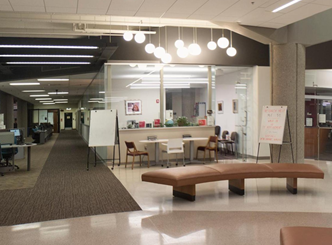
    Library #1 Reference office

5. 
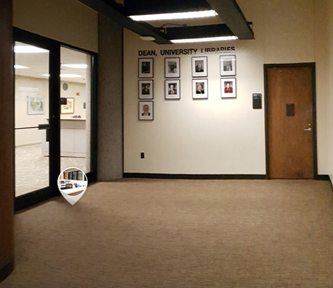
Library #1 Administrative office

6.    Michelle Caswell and Marika Cifor, “From Human Rights to Feminist Ethics: Radical Empathy in the Archives,” Archivaria, 81 (Spring 2016): pg. 25.

7.    Maria Accardi, Feminist Pedagogy for Library Instruction (Sacramento: Library Juice Press, 2013), pg. 40.

8. These could be similar to the glass covers that some libraries already use to cover glass at the entrance of the building for event signage.

Thursday, March 8, 2018

Can We Design for the Subaltern? | Jonathan Calzada


As I write this academic blog post, I contemplate the appropriate tone and prose subsequently forcing myself into a bifurcation of which I can only take one path. I can write in short and clear sentences in the hope that my ideas are interpreted as I intend. Alternatively, I can attempt to construct rich and referential text that leave the non-academic readership without means of comprehension nearly as effectively as Gayatri Chakravorty Spivak left me when I first read her work. This is a critical point where a design decision takes place. It is one of many such decision points in a constant process of production. As a software designer, I have worked under similar (if not the same) standards of production. Standards that are calibrated by notions of the imagined consumer. The path I take when I encounter a split in the road between simplicity/accessibility and complexity/inaccessibility says more about me and the institutions for whom I produce, than the very meaning of my work. The effectiveness of my work is lost or found in its design.

Producing for dominant institutions often excludes more consumers than it includes thereby rendering a vast range of them invisible. The human production of ideas begins with the craft we employ to represent them, as we strive to give them form such that they are conveyed intact to the imagined consumer. This does not only beg the question of who the imagined consumer is but also leads to a realization that it is “I” (the designer) who is performing the imagining and forming representations of the consumer. In this light then, for whom do we ultimately design and produce? Is it satisfactory to design/produce for our imagined representations of the consumer? Given these parallels within academia (theory) and software design (praxis), I want to use the term representational-production to include the process of information design in both spaces, and ask if we are capable of designing for the subaltern? [1]

Software as it is designed today is imbued with the worldview and representations of the imagined user and their identity coming from a non-subaltern worker/producer. For example, Western software companies tend to classify users by creating User Experience personas based on their conceptualization of the user. Academia can be seen to do the same representational-production work through classification of their readership or academic consumers. To some degree both claim that they are producing for the best interest of their consumers. Olson connects this process to hegemonic power by stating that “classification and thesauruses are hierarchical structures that award position based on conceptualization by a central power whose worldview purports to reflect the values of the population” (Olson 2010, 299). I have designed software with such specificity in the past. When I did in fact think about some of the classification of users/personas including who the unimagined user could be, I did so with a limited representation of them. Even after conducting usability studies, interviews, and ethnographic research with the ‘ideal’ consumer, I found representation to be problematic. To illustrate this problem, I will reference Spivak’s vertreten and darstellen distinctions of representation, and by using my own history, I will expand on how even representing oneself is fraught with imperfections given a temporal dimension.

The Problem with Representation of the Self & the Other: Temporal-Representation
I can (only) truly represent myself in my current state of self. In the years prior to my academic training, professional standing, US citizenship status, and the ability to speak English, I did not have a voice in this country. As a young boy, I found myself in the principal’s office too many times blamed for actions I did not take or incidents I did not begin; but because I grew frustrated with accusations, and the ensuing arguments would place me there. I was one of five Latinos in a predominantly white elementary school. I did not have a voice then. When I spoke, no one believed me, even during the moments when they physically listened. Faces unlike my own looked at me in distrustful and unfriendly ways. I wish I could stand up for myself then as I do now. However, rather than this being a temporal impossibility, it is a representational one.

Today, I cannot represent myself as the person I was then. I am a different person. There was an imperceptible point of departure from the condition of a voiceless subject to the person that I am today. Now, I have ‘lines of social mobility’ that allow me to speak more than I ever could then (Spivak 1995). To attempt to represent that young boy today is to try to ‘unlearn my privilege’ and revert to that young state (Spivak 1995). If such a mental transformation were possible, I would simply just be him (then) and not me (today) once again not able to speak. I have memories, but every time I recall them, I recreate them in my mind attempting to experience the past. I remember most of the details, but I feel very different today. How can I represent that boy now? Spivak makes a distinction between representation (Vertretung) and re-presentation (Darstellung) (Spivak 1995).  Representation (Vertretung) as in politics and speaking on behalf of others does not assume the representative to be in the embodied experience and condition of those who are being represented.  Re-presentation (Darstellung) as in art and philosophy only attempts to reproduce the ‘presentation’ of the subject.  It ends up being a simulacrum with varying degrees of imperfection. How then can the subaltern speak for themselves if once they have acquired social lines of mobility, they stop being subaltern and in turn leave their younger and voiceless selves in the irretrievable past?

I can only politically represent my younger self today. I cannot be that boy any longer, for the attempt alone would be disingenuous. It is not squarely an Einsteinian categorical problem of time travel—which he argued was an impossibility—but more precisely a representational (Vertretung) one. It is a temporal-representational problem of the self. If your life originated as an ‘other’ (perhaps even a subaltern), a split may occur through the course of your life where you begin to make the connections, gain the social and cultural capital within a system that allows you to mobilize and be heard. Your voice begins to take form, substance, and gain decibel levels. You can hear yourself through others that have heard your voice. You can even hear yourself through the type of ‘other’ that you were once before. In this new world, the self does not exist without the reflection of the other. In this new world, you can speak. In this world your former self has become the ‘other.’

How then do you design for the ‘other’ especially if s/he is you or rather your former self? After all, who knows you better than you know yourself? I begin with designing for your former ‘other’ to foreground the most obvious of problems with representation. Spivak uses semiotics to articulate this point. She critiques Deleuze and Foucault as post-structuralists having done away with the signifier/signified rendering a transparency in which there is not a need for representation. Within this framing the ‘other’ and the subaltern can speak, and therefore help themselves out of their struggle. However, as I have argued above “experience itself is constituted through representation,” as it is even problematic to represent oneself let alone the ‘other’ and even much less the subaltern (Kohn and Reddy 2006). In Spivak’s words “representation has not withered away” and is in fact problematic particularly because the medium such as language can be coerced by power dynamics favoring a hegemony (Spivak 1995). Representation then cannot be taken for granted as a transparent and authentic process. Reflexive interpretation may be necessary to design for the ‘other’ and the subaltern. Reflecting on the fact that as a producer/designer working for a prominent institution, you are not a subaltern or even an ‘other.’ You are neither because you have voice. You are not a subaltern because you have social connections that make any degree of upward social mobility possible. Is deep reflexive interpretation of representations of the ‘other’ a key step toward designing for the subaltern? If not, what representational-production work needs to take place in order to design for the subaltern? More importantly, what compels you (or me) to try to design for the subaltern in the first place?

The Object of Seduction that Compels Designing for the Subaltern
How can the non-subaltern produce/design for the subaltern and like it? What compels those who can speak to produce/design for those who cannot? In the current state formation where power is embedded in all modes of production through capitalism, the most obvious ‘object of seduction’ is capital. It is ultimately a self-defeating and tautological argument. What interests the ‘representing intellectual’ or capitalist is the continuation of the status quo or oppressive system that leaves the heterogeneous subaltern serving them on the periphery within a fragmented and unrecognized/invisible labor force. Within a capitalist framework, how is it then possible to provide such an object of seduction if that (capitalist) object ends up sustaining the immensely profitable system that placed the subaltern in a state of struggle in the first place? Who, if anyone, will be the subaltern representative (Vertreter) “that sends them rain and sunshine from above?” (Spivak 1995). What compels, coerces, or convinces the colonial/capitalist masters to dismantle their system that defines their purpose for being? More personally, how do I learn, grow, or force myself to like designing for the subaltern if there is not an object of seduction, remuneration, or any sort of recognition for me?

Conclusion
The cognitive bifurcation to which I referred at the beginning of this blogpost was created when I started to write, which now seems far behind. I made a conscious decision to check my privilege and then take a path. I chose to overcomplicate things. As it turns out, I write for myself, the academy, and for my institution. None include the subaltern or even the ‘other.’ There seemed to be no object of seduction for me to keep things simple. It simply does not pay and so I continue to sustain the ivory tower of academia in its ‘rightful’ place high above the ‘uneducated,’ unrecognized, and un-designed-for consumer. I keep the representational-production within a self-serving circle. I did not co-create with those I am ‘trying’ to help or even try to interpret their needs or wants. In fact, I have not answered anything and wrote too much. I end up with the same question and so I keep asking if we are capable of designing for the subaltern? [1] In asking the question it implicates political, historical, and ethical concerns that mainstream techno-society does not currently recognize or acknowledge. Instead the subaltern is displaced, sanitized, and their context removed from the record/systems. However, the thesis question itself places the producers/designers in a reflexive mode recognizing their privilege and limitations, especially with representation. In fact, the question itself may be impossible to answer fully because of the problems inherent within representation, but the fact that we are employing it as a method to reflexively interrogate design practices is, I argue, an ethical imperative to designing/producing technology/software that aims to liberate the subaltern.


Notes
[1] Discussing Spivak with Peter Pollack we re-contextualized vertreten and darstellen within software design to come up with the question: can we design for the subaltern and like it?.

References

Gayatri Chakravorty Spivak, “Can the Subaltern Speak?” As reprinted in The Post- Colonial
Studies Reader, Bill Ashcroft et al, eds. New York: Routledge, 1995, 28-37.

Kohn, Margaret, and Kavita Reddy. 2006. “Colonialism.”

Hope Olson and Melodie J. Fox, “Gayatri Chakravorty Spivak: Deconstructionist, Marxist,
Feminist, Postcolonialist,” in Critical Theory for Library and Information Science (Santa
Barbara: Libraries Unlimited, 2010), 295-309.